

Introducing the Bad Services Corporation
Today we launched Bad Services, the long awaited sequel to Good Services.
Bad services is about why organisations struggle to produce services that work. It’s a great resource if you’re wondering why it’s so hard to design services that work and what you can do about it, but we wanted to bring some of the problems in the book to life in a way that would help people to truly understand what we mean when we say something is a ‘badΩ service’
You might have landed here because you visited the Bad Services Corporation staff induction, thinking, what is this?!
To be really clear, The Bad Services Corporation isn't a real company, it’s a satire, but one with a purpose.
By creating it, we set out to explore, expose and interrogate what makes a bad service. To pull at the threads of what feels like a common experience for many.
We spend 15 billion hours on ‘life admin’ every year (in the UK) and despite decades of promises that new technology alone will alleviate us from this burden, we’re left with a question of why are some services still as bad as they are?
As the book Bad Services says, ‘No one gets out of bed in the morning and sets out to make a bad service’.
The blame for who makes a Bad Services (almost) never sits with one person or team, instead bad services evolve over many years as a byproduct of a lack of purpose, a detachment from our users, a lack of understanding or our materials, inability to take risks, and a structure that doesn't work anymore. In short, the 5 causes of bad service design that are in the new book.
The driving force behind this counterintuitive behavior as society isn't easy to unpick. Are we in the fall out of late-capitalism and/or experiencing multiple polycrises? Many of us feel the inequities and absurdities of the modern economy.
Or is it a combination of monopolistic corporate power, measurement targets, exponential growth, relentless profit chasing, extractive IT contracts and obsessive technological progress?
Either way, our services exist in economic systems that have set the stage for these bad services to flourish.
We’ve been concerned for years about the degradation of services we experience everyday.
A decade ago we attended a conference at Parsons School of Design on Platform Cooperativism. Held the day after Trump’s first day in office, the day was full of grief for a future where the global impact of regulation-free capitalism could perpetuate forms of digital colonialism in unexpected ways. That was 2017, and it’s something we’ve been thinking and talking about ever since; in our post on Austerity Service Design, and through our podcast.
Wherever this driving force for what some have now come to call ‘enshittification’ comes from, one thing we can agree on is the result; we are trying to fix services in an extremely difficult set of circumstances.
When we started to think about how to launch Bad Services, we wanted to find a way to explore these circumstances in a way that didn't feel overwhelming, or like we were blaming the people trying to deliver or improve them.

Why humour?
Some of the best forms of resistance, and societal reflections have used humour to explore the ridiculous.
You can see this in the work of Led by Donkeys or Sports Banger, and in satires like In The Thick Of It! Yes Minister, BrassEye,The Office, Parks and Recreation or W1A. They all feel familiar yet uncomfortable. We recognize the characters and the scenes. They’re familiar because the uncomfortable truth is that they are the reality we all experience. We’re watching what we know.
Humour allows us to experience the darkness of reality up close, but with a sense of safe removal from the actual situation. With that distance, we get to see a slightly bigger picture than we would otherwise.
Good satire often exposes the patterns and origins of difficult truths and brings us closer to questioning the wider system influencing it as a whole, helping us to ask, how did we get here? One of our favourite books on just how powerful this can be is Can Jokes Bring Down Governments by Metahaven.
It’s this humorous distance that we tried to create with the Bad Services Corporation.

We wanted a way to expose the familiar patterns of Bad Services whilst exposing the bigger system dynamics at play that creates the conditions for this to happen. To shine a light on the de-humanising of staff delivering services, the reduction of their rights through surveillance and the impact this has on the services they deliver.
Comedy has helped us to interrogate these things with a magnifying glass.
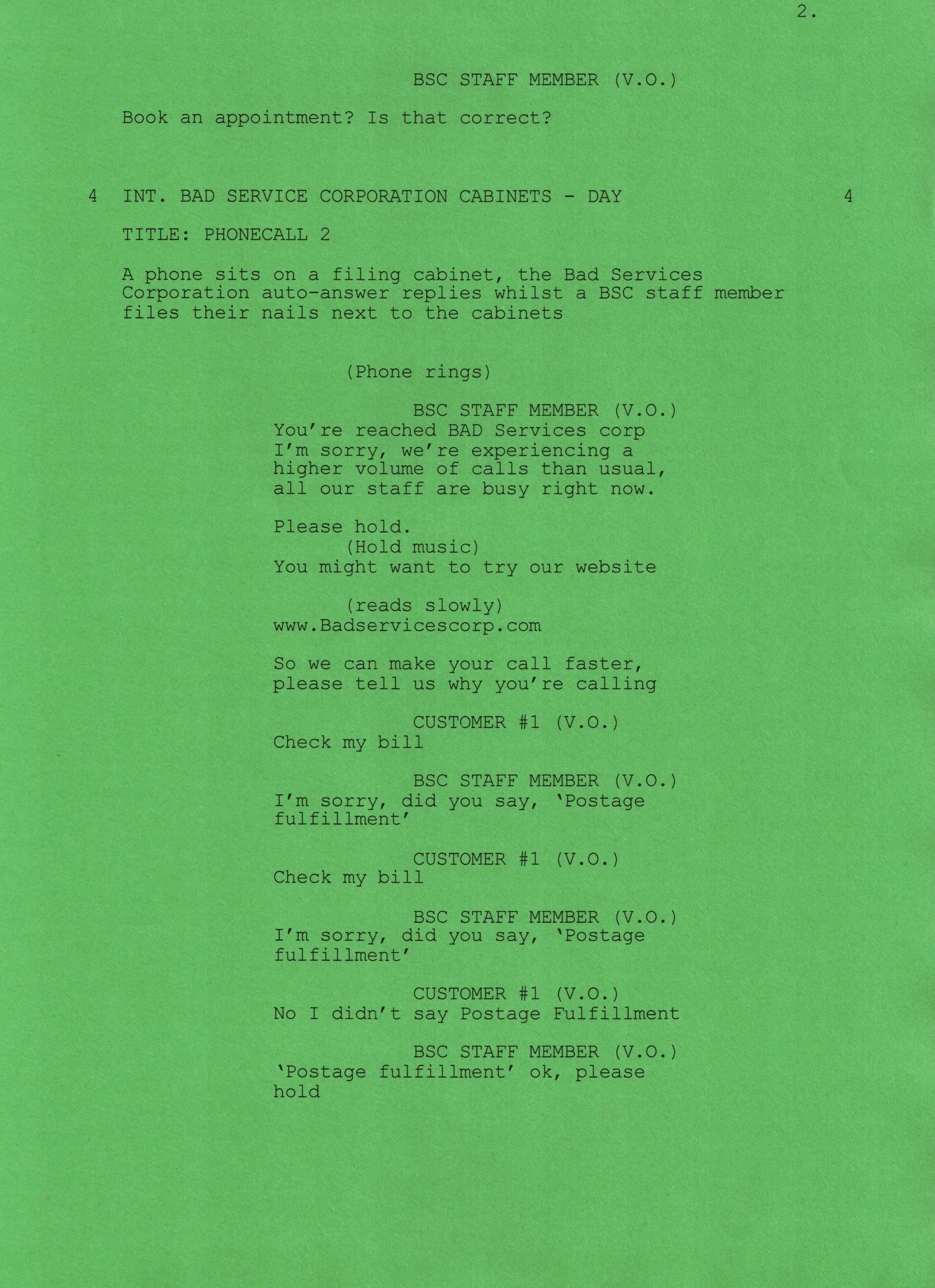
The script we wrote purposefully set out to do this by inverting the 15 Principles of Good Service Design as the 15 Principles of Bad Service Design, as if they were a deliberate corporate strategy for new staff to be inducted into. The point being of course, that sometimes these failures feel deliberate, we rarely if ever intend to work in this way.
We wanted to highlight the ludicrousness of the difficulties we experience as users of services as a result, but also the experience staff have to suffer when they are incentivised, measured and monitored into playing a role in this.
This over-monitoring of staff is not just a parody more and a reality in places like Burger King who are adding AI to Employees’ Headsets to Constantly Monitor Whether They’re Being Friendly Enough.
We worked on many details in the development of Bad Services Corporation, down to the props and costumes.
We dressed our staff in bright green Bad Services chore jackets as a play on the hipsterfication of workwear, the trend of adopting working-class symbols in a search for authentic belonging.
Through a semiotic lens, we wanted to trace how meaning has shifted: from the original blue workwear jacket, the Bleu de Travail, to a new kind of "collar" that's neither blue nor white, but something in between. It seems global firms are now chasing a new flavour of working-class authenticity, one earned not through manual labour, but through people labouring at screens.

Only days after we shot the film, we came across an article about Palantir, the AI-powered surveillance company, releasing its own French-blue-style chore jacket as merch. Almost too on-the-nose to be satire.
By creating the Bad Services Corporation we wanted to build something that could become a mechanism to expose the familiar experiences users and staff have of bad services now and in the future.
All of what we’re portraying is the reality, we’ve just turned up the exposure dial and laid it bare, close up, for us to have a conversation.
We’d say we hope you enjoy it but we hope you’re uncomfortable.
There’s more to come, but for now, make sure to do your staff induction.
Please ensure to rate us highly.