

15 billions hours are wasted each year dealing with broken services, but do we care enough to fix it?
Bad services are everywhere we look.
Services that are unfindable, incomprehensible and leave our users unprepared. They’re riddled with breaks, blockers and repetition, and they spread their negative consequences far and wide. They’re either too slow, too fast, inaccessible or require endless effort or pre-use-learning. Worst of all, they shift the blame of their failure back to users, creating risks in abundance and wasting vast amounts of time and money in the process.
A 2022 paper by the UCD Geary Institute for Public Policy in Dublin (Martin, Delaney and Doyle, 2022) found that we spend an estimated 15 billion hours in the UK each year ‘administering our personal lives’. That’s roughly an hour per day paying bills, requesting refunds, locating our pensions, making a complaint, losing our customer ID and a plethora of activities involved in ‘life admin’. At a median hourly wage, that’s £200 billion of time. We made a tracker that you can explore this data in more detail here and see how much ‘life admin’ time has elapsed from the start of the year.
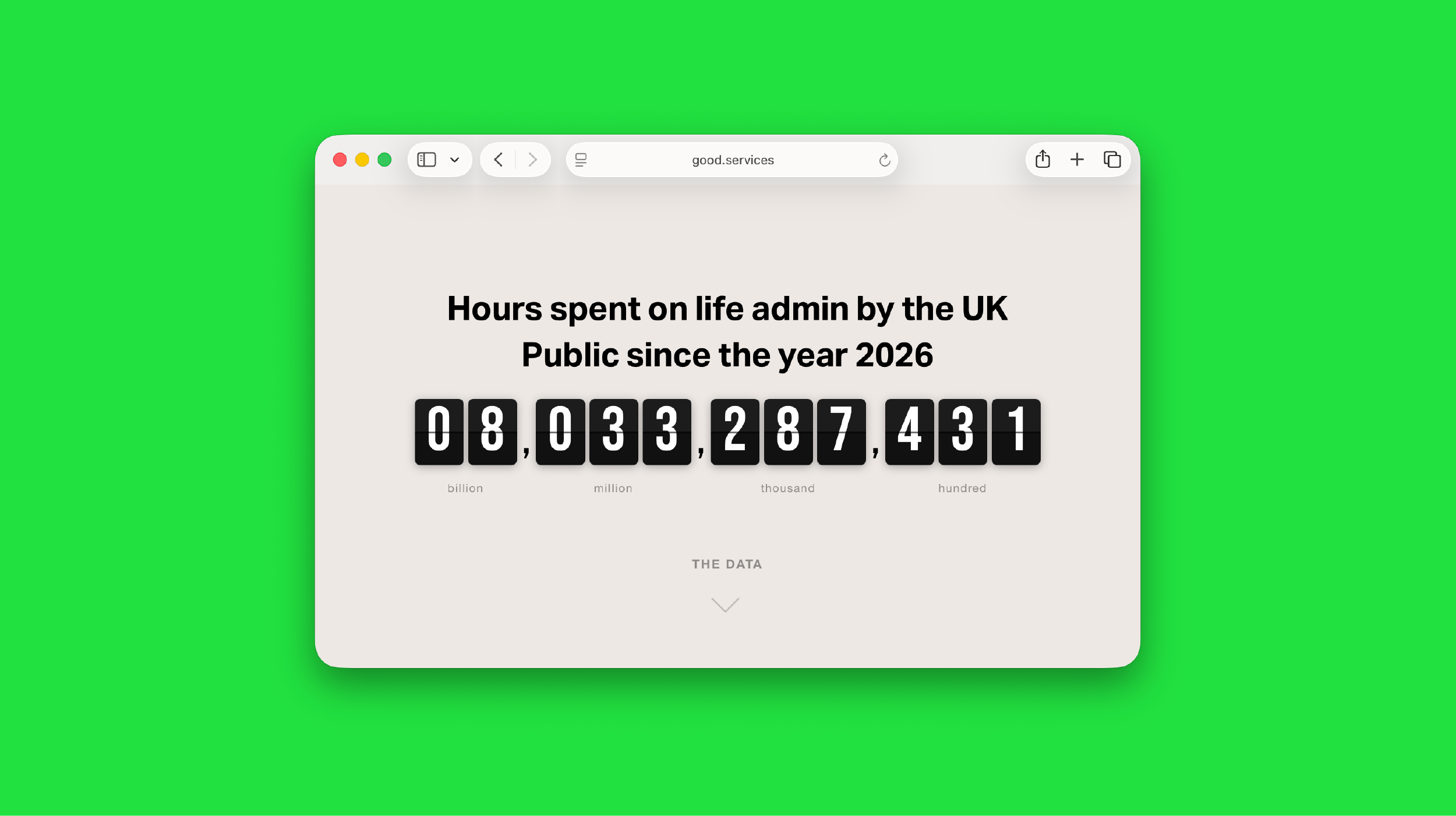
To put this into context - this is worth the same amount as the total income of everyone working in the construction industry and financial services in the UK combined (61 billion and 99 billion in 2023 respectively).
Of this 15 billion, a mere 3 billion hours is spent on public services.
Although this burden is disproportionately paid by more vulnerable people who need to interact with public services the most, the vast majority of our time is spent dealing with the sludge of just-good-enough-not-to-get-sued private sector services. Although this tipping point of getting sued seems to be getting slightly nearer, see the news on Virgin Media being fined by Ofcom for hanging up on customer calls.
This is not something for the public sector to celebrate. A 2025 study on the ‘state of (UK) digital government’ showed that, despite the internet being officially middle-aged, nearly half (47%) of central government services still have no digital pathway. Of those that do, they use more than 40 ways to verify the identity of users. Certain services standout in the financial size of their problems - there is a current outstanding debt of £251 million in ‘wrongly’ paid carers allowance caused by bad service design (users bear an unreasonable burden of reporting when their income is above a strictly calculated means tested threshold of eligibility).
Spotting bad services is easy when we’re looking at other people’s services. When it comes to our own, it can be more difficult.
Put (extremely) simply, the driving force behind most bad services is that we have become detached from the reality of how our services are experienced and how well (or not) they work. This detachment can be because we have lost touch with our users, our sense of purpose or the materials we’ve used to build our services.
Wherever this detachment happens, we find problems. We either don’t see the impact of our decisions on users, or we don’t see the impact of our users’ problems on our organisation. The feedback loop that we rely on to make good decisions has been severed.
Without it, we’re running on a heady mix of guesswork and self-belief.
The reason we’re struggling with this is almost never that we don’t ‘care’ about the problems our users are experiencing. More often, our organisation will be struggling with either;
Problems we don’t know are happening
Problems we know are happening, but don’t know how to solve (or that we solve in the wrong way)
Problems we know are happening, and how to solve, but that we struggle to prioritise because something else is always ‘more important’
When we are in this situation we have 3 options on what we do about it:
Option 1: Help everyone see and understanding the problems that our users are experiencing and prioritise these problems accordingly
This work is vital, but it takes time. Relying purely on creating a culture where we instinctively ‘put the customer first’ makes prioritisation difficult, as we end up comparing apples with pears. User needs and financial or risk based priorities are very difficult to prioritise together unless we have some sense of what risk or financial impact the problems our users are experiencing have on our organisation
Option 2: Translate the problems our users have into the language our organisation understands (ie. money or risk)
If we can translate the issues our users experience into financial or risk implications these things have on our organisation (and our users) then we can stand a chance of weighing them up against all of our other priorities that we more readily have this information for. The issue that we have with this approach though, is that this requires;
1. Realising that this is important (which we often dont!) and;
2. Accounting and economic skills that we often don’t often have in user centred professions
We also add a significant overhead to our work to constantly justify the financial impact of our work when this is often hard to measure as it has such wide impacts.
Both option 1 and 2 are important to do, but they won’t unfortunately solve the issue we have at hand which is why we have developed such a separation with the expereince our users are having with our services that we believe to be true.
This is where options 3 comes in
Option 3: Understand why these problems are happening and solve their root cause
This means diving into the five causes of bad service design in Bad Services and understanding the root cause of our difficulty in seeing and engaging with who our users are and what they need alongside the difficulties we experience in doing something about these problems.
None of these are easy routes to take, especially as they often need to be done at the same time.
But it’s often only by taking all of these options that we can enable better services to happen.