

How do we work out who our users are and what they need?
When we think about who the users of our service are, it is tempting to only think about the ‘end’ user or customer. The patient in the hospital, the recipient of a passport, the buyer of a car.
Whether or not these people get what they need should be our focus, but if we only think about designing for these people, we often miss vital links in a ‘chain’ of users who are involved in providing that service to our end user.
These people have needs too and if we don't meet those needs, they won't be able to help our end user get to where they need to be. We might also miss important impacts our user has on other people, society or the planet as a result of using our service.
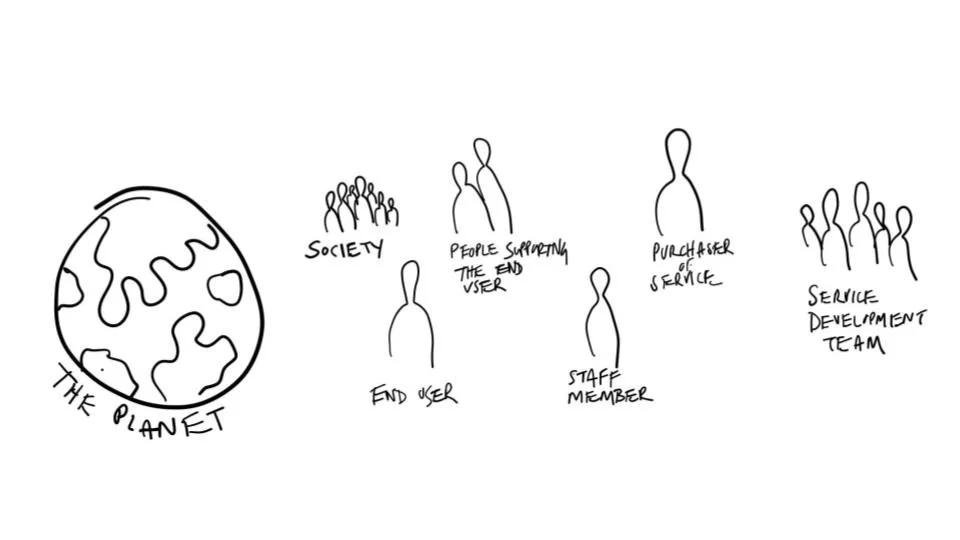
That’s why it’s helpful to think about a ‘chain’ of users who are involved in providing, using or being affected by our service.
If we are a B2B software company, we will have buyers of that software who need to be able to make a quick and accurate decisions on whether that service is for them, that buyer will be buying on behalf of staff members who will then provide an onward service to our end user. Our end user’s needs should inform our staff member/s needs, our staff members' needs should inform our software buyer’s needs and so on.
What often happens though, is disconnection or imbalance in the chain; where the needs of one group of users outweighs the needs of others. We design our service purely for staff members, only to realise that this makes things very hard for end users who need to interact with them. We think just about our end users and suddenly, it’s our staff who are finding things difficult.
Think about a ride hail app. We have drivers and riders. If we just design a service for one user group, the other suffers. What our riders need is a cheap, flexible ride home. What our rider needs is to earn a living, go home at a certain time, and take bathroom and food breaks.
If we design our service for riders? No bathroom breaks, no living wage, no working on your journey home.
If we design a service just for drivers? We have a service that is perhaps too expensive and inflexible. We need both users to be equally served.
Designing for our whole chain of users is about balance and compromise, not letting one user’s needs overrule everyone else's.
To work out what your chain of users is, think about:
Who is the end user/users of your service? This is the person your service is directed towards
Who helps your user to achieve this goal? What do they need to be able to do this?
Who benefits or is impacted by your user using your service? What do they need?
If you’re curious about other ways to help your organisation understand and prioratise user needs, check out Bad Services, out worldwide now!